Here's something most people don't know: CO2 above 1,000 ppm noticeably impairs cognitive function. At 1,400 ppm, cognitive performance drops by roughly 50%. A bedroom with the door closed after 4 hours of sleep regularly hits 1,200–1,500 ppm. A conference room with 6 people and poor ventilation can reach 2,000+ ppm in an hour.
I put a CO2 monitor in my home office after reading about this. My office, with one window slightly cracked on a cool day, averaged 1,050 ppm while I was working. On warmer days when I kept windows closed, it hit 1,400 ppm by early afternoon. Opening the window fully dropped it to 650 ppm within 20 minutes.
I was genuinely less sharp in the afternoons than I thought. Not tired. Not distracted. Just breathing air that made my brain work worse.
Air quality monitoring is one of the most underrated smart home investments. Here's what to buy.
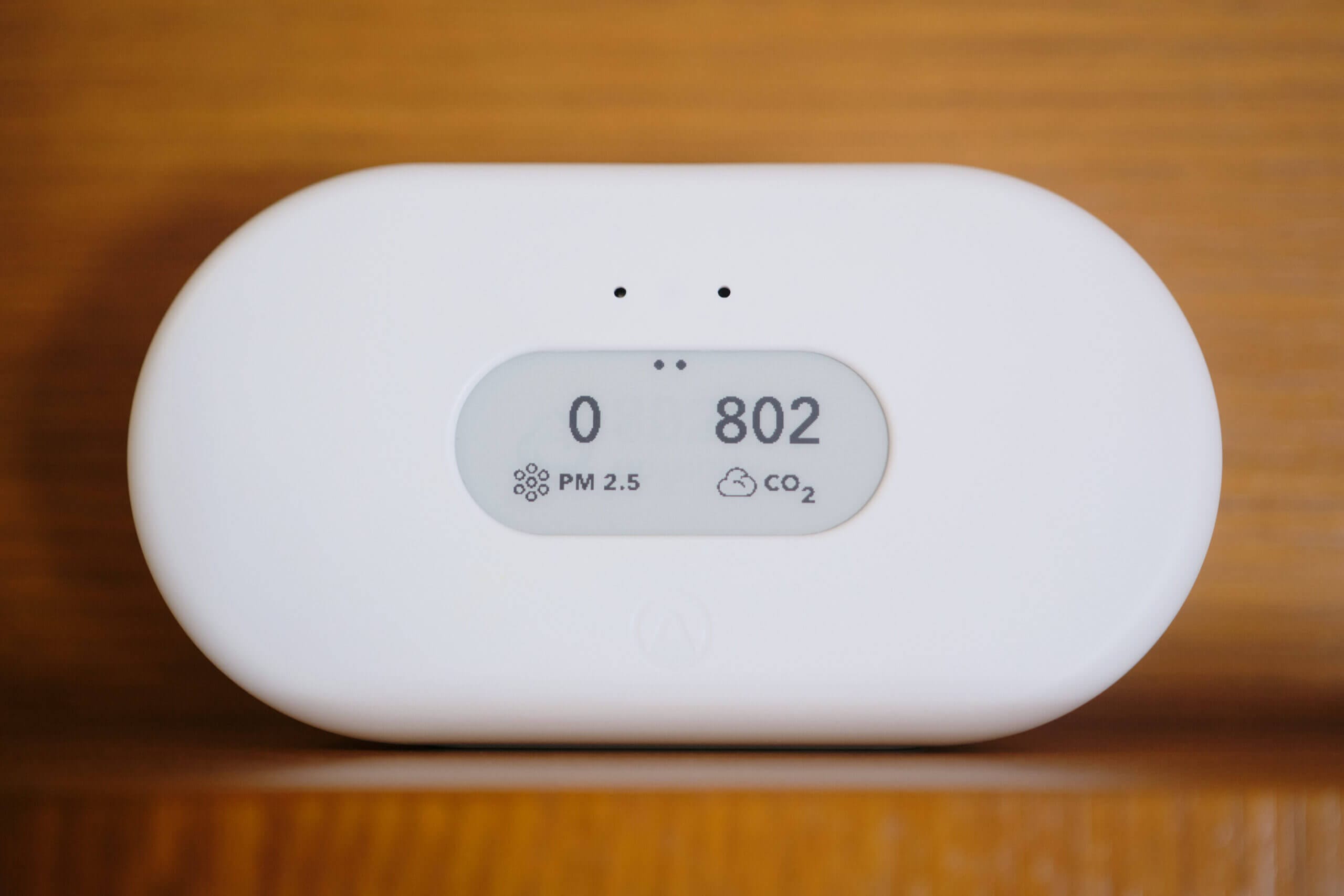
Airthings View Plus — ~$299
The View Plus is the most comprehensive residential air quality monitor available. It tracks: CO2, PM2.5 (fine particulate matter), VOCs (volatile organic compounds), radon, temperature, humidity, and air pressure. Seven sensors in one device.
The radon detection is what makes this unique in the category. Radon is a naturally occurring radioactive gas that seeps up through soil and can accumulate in homes — it's the second leading cause of lung cancer in the US after smoking, and most people have never tested for it. If you have a basement or live in a high-radon area, this alone justifies the $299 price tag.
The display: An e-paper display shows a readout at a glance. Configurable to show whichever sensor data you care most about. Battery-powered (2 years) or USB-C for continuous operation — I recommend USB-C if it's on a desk.
App and data: The Airthings app is detailed. Historical graphs, trend analysis, weekly health reports. Alexa and Google Assistant support. IFTTT integration for basic automations.
Home Assistant: The Airthings integration in HA works via their cloud API. All sensor entities are available — CO2, PM2.5, VOCs, radon, temp, humidity, pressure. I've used this for a year without major issues. The cloud dependency is a limitation; if Airthings' servers are down, your HA sensors go unavailable.
CO2 accuracy: NDIR sensor, ±50 ppm or ±3% of reading, whichever is greater. Independent testing consistently shows it reads 10–100 ppm high compared to calibrated reference equipment, but the correlation is strong — it accurately tracks changes even if the absolute number is slightly off. For behavioral decisions (open a window, ventilate the space), that's good enough.
Who should buy it: Homeowners who want the most comprehensive picture of home air quality, anyone who wants radon monitoring included, and households with members who have respiratory sensitivities.
Awair Element — ~$149
The Awair Element is the best value choice for most people who aren't specifically concerned about radon. It tracks PM2.5, CO2, VOCs, temperature, and humidity — five key metrics — in a clean, well-designed package.
The Element's design is noticeably nicer than most competitors. Natural wood finish, LED strip that changes color based on air quality score, and an unobtrusive form factor that fits on a desk without looking industrial.
App quality: The Awair app is the most user-friendly in this category. It provides not just raw numbers but an "Awair Score" that summarizes overall air quality, plus specific recommendations ("Open a window," "Use an air purifier"). My wife actually checks the app unprompted — that's the real usability benchmark.
Smart home integration: Works with SmartThings, Alexa, Google Assistant, and IFTTT. No HomeKit. No Matter. The SmartThings integration is particularly good — Awair has a documented local API that SmartThings uses.
Home Assistant: Strong HA integration. Local API option available (not just cloud). This is a meaningful advantage — local API means your automations don't break when the internet goes down. I use the Awair CO2 sensor in an HA automation that opens my smart window blinds when CO2 exceeds 1,100 ppm.
No radon detection: If you're in a low-radon area or have already tested your home (which you should do anyway with a $20 test kit), this isn't a limitation. If radon matters to you, get the Airthings.
Pricing note: The Awair Element is frequently on sale at $119–$129. At that price it's one of the best smart home sensor investments available.
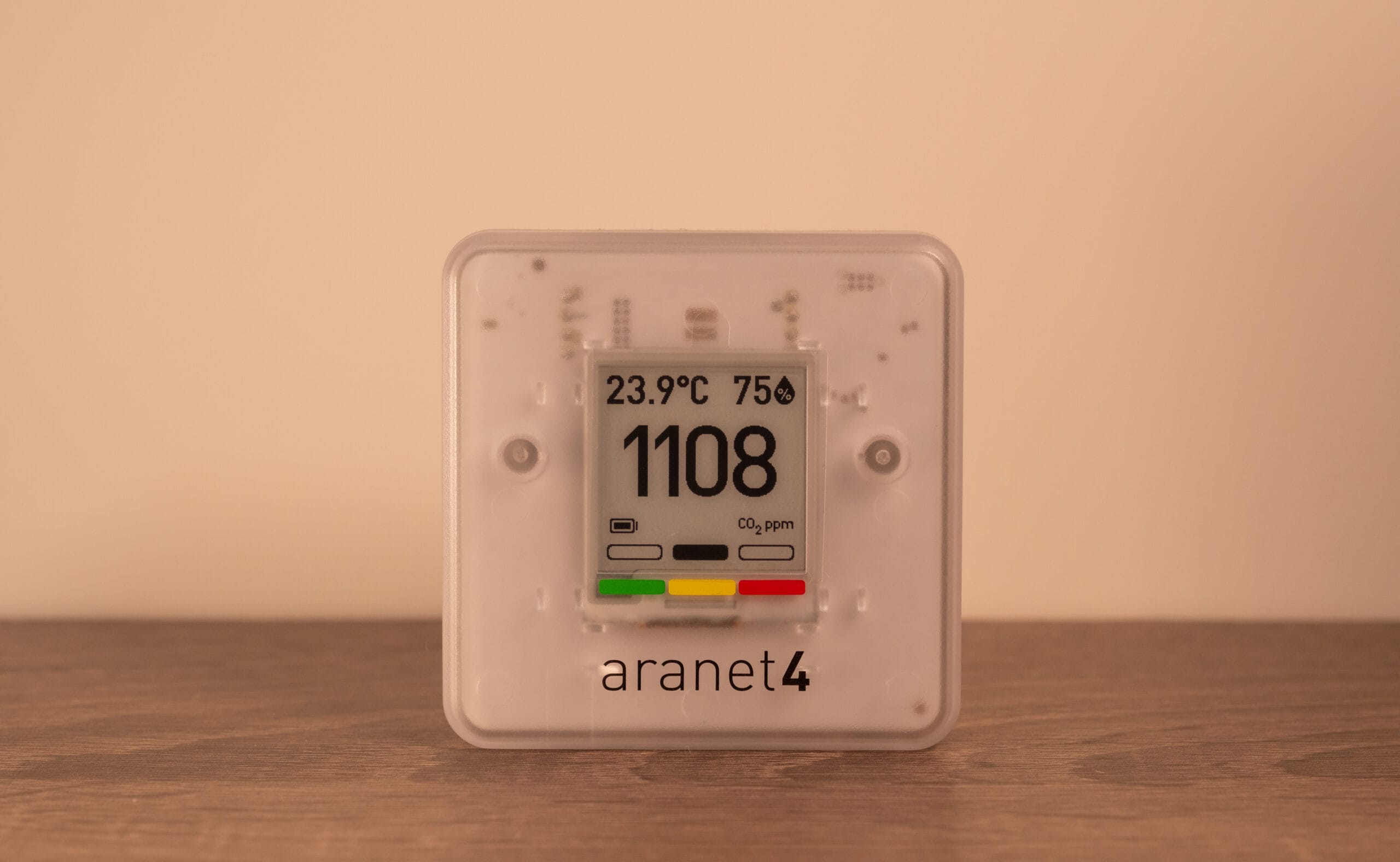
Aranet4 HOME CO2 Monitor — ~$170
The Aranet4 does one thing and does it better than anything else: measure CO2. If CO2 is your primary concern — for focus, sleep quality, or ventilation monitoring — this is the pick.
The sensor inside is the SenseAir S8, which is professional-grade NDIR equipment used in industrial monitoring applications. The accuracy is ±50 ppm or 3% of reading — same spec as the Airthings, but independent testing consistently shows the Aranet4 reads closer to calibrated reference equipment. The factory calibration process includes an additional verification step after the sensor is integrated into the final device.
Design: Small, credit card-sized device with an e-ink display. Shows CO2, temperature, humidity, and atmospheric pressure. A three-color traffic light indicator (green/yellow/red) gives you an immediate visual status. The e-ink display is readable in any lighting and draws negligible power.
Battery life: Up to 4 years on two AA batteries. Genuinely exceptional.
Portability: I carry mine between my home office and living room. I've taken it to hotel rooms to check ventilation quality. It's the only CO2 monitor I'd describe as genuinely portable.
Connectivity limitation: Bluetooth only. No Wi-Fi, no direct smart home integration without a bridge. The Aranet4 app shows historical graphs, but real-time cloud sync requires the Aranet PRO version or third-party integration.
Home Assistant: Possible via Bluetooth integration. HA picks up the Aranet4 via Bluetooth Low Energy and exposes CO2, temperature, humidity, and pressure entities. Works well once configured, though Bluetooth range can be limiting. I run mine with a Raspberry Pi-based Bluetooth proxy to extend the range.
Who should buy it: Anyone who wants the most accurate CO2 reading available in a consumer device. Office workers monitoring workspace ventilation. People optimizing sleep environments. Anyone who wants portable air quality awareness.
SwitchBot Air Quality Monitor — ~$70
SwitchBot's entry into air quality monitoring is a compelling budget option. For $70, you get CO2, PM2.5, temperature, and humidity tracking. The display is clear and the SwitchBot Hub integration enables it to participate in SwitchBot automations — useful if you already have SwitchBot devices.
The trade-off: The CO2 sensor is not NDIR — it's an NDIR-equivalent sensor that SwitchBot describes as providing "indicative" readings. In practice, the accuracy is lower than the Aranet4 or Airthings. For behavioral guidance (roughly when to ventilate), it's fine. For precise readings, it's not.
Home Assistant: SwitchBot hub integration brings the sensor into HA. Works for basic automations.
Who should buy it: SwitchBot ecosystem users. Budget-conscious buyers who want a starting point.
uHoo Smart Air Monitor — ~$299
The uHoo is the most sensor-dense consumer air quality device: CO2, PM2.5, PM10, VOCs, ozone, NO2, carbon monoxide, temperature, humidity, air pressure, and a virus weather index. Nine air quality parameters.
At $299, it's the same price as the Airthings View Plus without radon detection. The breadth of sensors is impressive and justifies the price if you're concerned about NO2 (common near gas stoves and busy roads) or CO specifically.
Home Assistant: API-based integration. Works via community-maintained integration.
Who should buy it: Households near busy roads, anyone with gas appliances and concerns about combustion byproducts, or people who want the most comprehensive picture possible.
The Recommendation by Use Case
You want comprehensive air quality monitoring: Airthings View Plus. The radon detection alone is worth the price for many households.
You want the best value for CO2 and general air quality: Awair Element at $149. Clean design, good app, local API for HA.
You want the most accurate CO2 reading: Aranet4 HOME. The SenseAir S8 sensor is the standard by which others are measured.
You're already in the SwitchBot ecosystem: SwitchBot Air Quality Monitor is a reasonable budget addition.
One More Thing
Once you start monitoring CO2, you can't stop. You'll open windows differently. You'll notice your afternoon focus issues are ventilation problems, not discipline problems. You'll check the kitchen levels after cooking. You'll understand why a long car ride with the windows up feels draining.
Get a monitor. Try the Awair Element at $149 if you want a starting point. The data changes how you live in your home.