Building a smart home costs money—but it doesn't have to. I've watched the price of good sensors and controllers collapse over the last few years. Now you can build a genuinely capable smart home for less than people spend on a single "premium" smart switch.
The trick is knowing which budget devices are actually worth buying and which ones are cheap garbage. I've tested hundreds of them at this point. These ten made the cut.
1. Sonoff SNZB-02D Zigbee Temperature and Humidity Sensor (~$10)
The SNZB-02D is my goto recommendation for anyone building a Zigbee network. It's got a tiny LCD that shows temperature and humidity right on the device. Battery lasts eighteen months. The case is minimal and doesn't look ridiculous on a shelf or nightstand.
It joins any Zigbee network. Reports fast. Has a good range. For ten dollars, it's hard to beat. I have four of these spread around my house, and they've been flawless.
2. ThirdReality Zigbee Smart Plug (~$13)
The smallest Zigbee smart plug I've found. Honestly tiny—barely bigger than a standard outlet. It has energy monitoring built in. It supports Matter and Thread, which is increasingly important. Just plug it in and it joins your network.
The fact that it's Matter-compatible at this price point is remarkable. Most Matter plugs cost thirty dollars and up. This one does the job for thirteen bucks.
3. Shelly Plus 1 (~$14)
I wrote a full review of this one because it deserves it. It's a Wi-Fi relay that fits behind your existing light switch. Makes any dumb switch smart without replacing the switch. Local API, Home Assistant compatible, works with anything that's not a major appliance.
I keep finding new uses for these. Exhaust fans, garage lights, irrigation valves. At fourteen dollars, they're basically the best value in smart home hardware.
4. Aqara Door and Window Sensor (~$12)
Magnetic sensor. Zigbee. The battery lasts two to three years on a single CR2032 coin cell. Barely larger than a thumb drive. Works with HomeKit, Home Assistant, anything that speaks Zigbee.
This is the sensor I recommend when someone asks what to buy first. Cheap, reliable, small. You can hide it on a door frame and nobody sees it.
5. WLED-Compatible LED Strip Controller (~$8)
This one's for people who want to run addressable LED strips (the kind with individual addressable LEDs like WS2812). It's an ESP32 or similar, preloaded with WLED firmware. You just power it, connect the data line to your LED strip, and go.
WLED has a beautiful web UI and supports Home Assistant via MQTT. You can animate your lights, sync them to music, control them from your phone. At eight dollars, you're basically getting the controller for free and the software is a bonus.
6. ESP32-C3 Super Mini (~$3)
This is for the tinkerers. Bare ESP32 board, about the size of a zippo lighter, costs three dollars. Load it with ESPHome and you've got a tiny Wi-Fi device that can run any sensor you want. Temperature, humidity, motion, door sensors—wire it up and make it do something.
It's not for beginners. But if you know how to solder and code a little, it's the cheapest way to make a custom sensor for whatever you're trying to measure.
7. Sonoff SNZB-06P Zigbee Presence Sensor (~$18)
mmWave presence detection at a budget price. This sensor knows when someone's in a room, even if they're sitting still. No passive infrared nonsense that gets fooled by sunlight and heating vents.
Eighteen dollars for mmWave is a steal. The sensor integrates into Home Assistant and HomeKit. Battery life is decent. It's the best way to automate lights that turn on when you enter a room and turn off when you leave.
8. Govee Wi-Fi Water Leak Sensor (~$12)
Wi-Fi water sensor that doesn't need a separate hub. Alerts your phone instantly if water is detected. Built-in 100 dB alarm will wake the dead if you're home. Works under your water heater, washer, dishwasher—anywhere water might pool.
At twelve dollars, it's cheaper than a single professional water detection service call. If it saves you from a flooded basement once in your life, it's paid for itself a thousand times over.
9. TP-Link Tapo P125M Matter Smart Plug (~$15)
Wi-Fi smart plug with Matter support. Energy monitoring. Works with HomeKit, Alexa, Google, and anything else that speaks Matter. The Tapo app is fine. The plug itself is compact.
Fifteen dollars for a plug that works with everything is excellent value. If you're building a Matter network, this is the cheapest entry point for Wi-Fi plugs.
10. Ikea TRÅDFRI Zigbee Smart Bulb (~$8)
The entry-level smart bulb. Zigbee, 16 million colors, works with any Zigbee coordinator. The newer versions have Thread support built in, which means it can act as a border router for your Thread network.
Ikea keeps these cheap because they want to sell you their entire ecosystem. Good for us because we get an eight-dollar Zigbee bulb that works everywhere. Buy four and stick them in lamps all over your house.
Building a Network on a Budget
Here's the thing about smart homes: you don't need to spend a fortune on a few premium devices. You need a bunch of cheap devices that talk to each other.
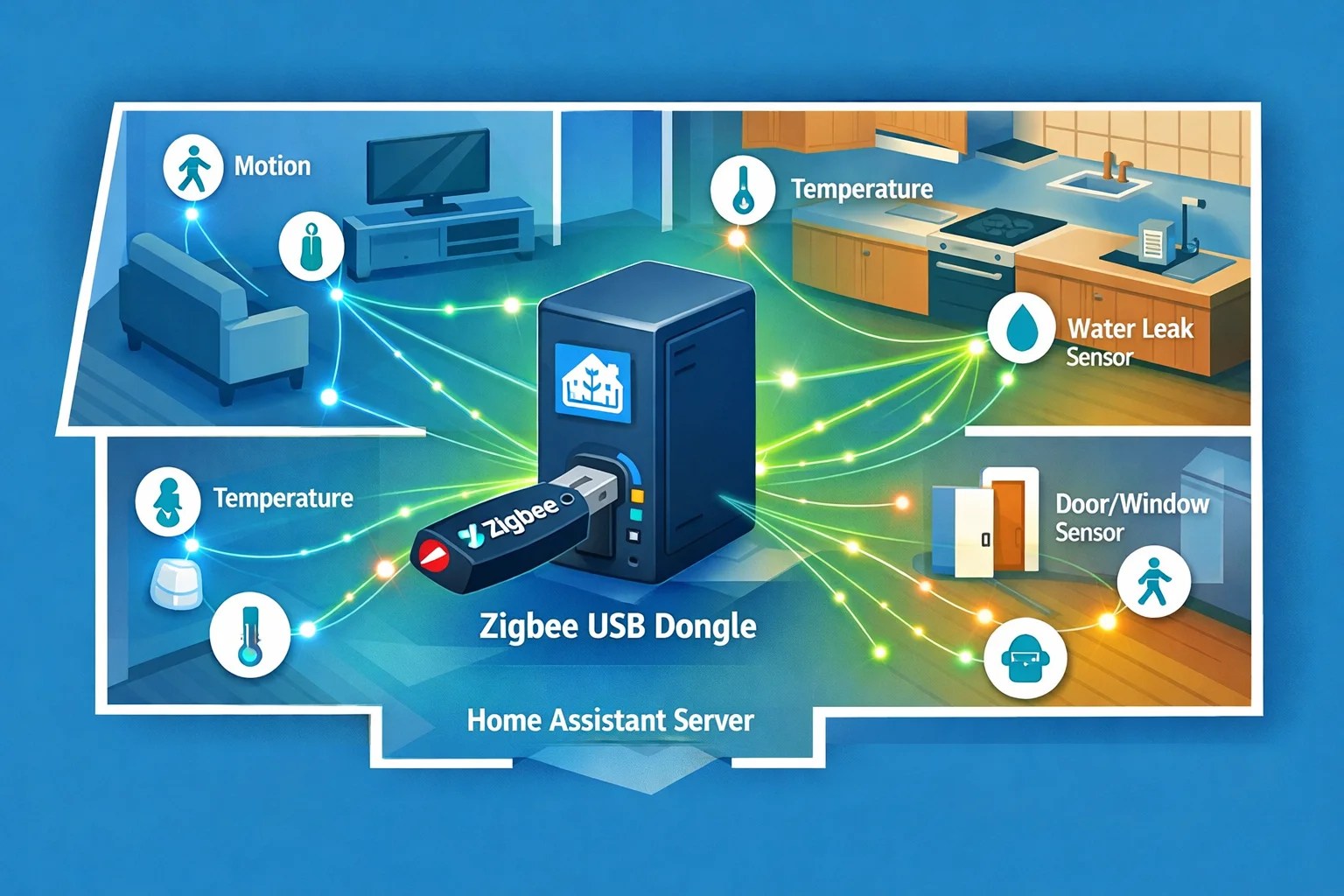
Start with a Zigbee coordinator—something like the ConBee II or Sonoff ZigBee 3.0 USB stick (~$25-30). That's your hub. Then add a handful of these sensors and plugs. At under twenty dollars each, you can afford to experiment.
You'll end up with a robust home automation network that costs a fraction of what a single high-end smart home company would charge you. And because most of these devices work with Home Assistant, you own the whole thing. No subscriptions. No cloud dependency.
The trick is knowing which cheap devices are actually decent, and which ones are trash. These ten are the good ones. I've tested them, lived with them, and integrated them into my own home. They work.

The Math
If you buy all ten devices listed here, you're spending about $125. That gets you:
- Three ways to add sensors to your network (Aqara, Sonoff, custom ESP32)
- Three ways to control things (Shelly relay, smart plugs, LED controller)
- Three different connectivity options (Zigbee, Wi-Fi, hybrid)
- Coverage for temperature, motion, water, light control, and more
Compare that to a single "premium" smart home hub setup and you're talking about saving hundreds of dollars while actually getting better flexibility.
The smart home industry wants you to think you need expensive devices. You don't. You need the right cheap devices. And these are the right ones.
Browse affordable smart home devices on Amazon
Start small. Buy one or two things that solve a real problem in your home. Then expand from there. By the time you've spent $200, you'll have a better system than most people's $2,000 setups because you actually understand how everything works.